|
Netflix Is Launching Its Own Ad Tech
Source: AdExchanger
May 15th, 2024

Summary: With its ad-supported tier reaching 40M monthly global active users, Netflix will begin testing its new in-house ad tech platform in Canada this year before rolling it out in the US by Q2 2025 and globally by late 2025. The streaming giant launched its ad-supported subscription tier in late 2022, and has been working exclusively with Microsoft to monetize its ad inventory via direct and programmatic deals.
Beginning this summer, Netflix is adding SSP Magnite, and DSPs The Trade Desk and Google’s DV360 as partners. Buyers will be able to access Netflix inventory through programmatically these platforms. Netflix has also partnered with iSpot and TVision for measurement, adding to a roster that also includes Kantar, Cint, NCSolutions, Nielsen, EDO, DoubleVerify, and Integral Ad Science.
During its first live upfront presentation last week, Netflix said more than 40% of all new signups are choosing its ad-supported tier, which had 5M users a year ago and 23M in January. To bolster viewing time, Netflix is exploring live streaming and sports partnerships. For the next three years, Netflix will stream Christmas Day NFL games, and it will begin streaming all WWE live events and shows, including Raw.
Opinion: As the industry's largest streamer, Netflix has a major opportunity in the ads space. In order to grow its ads business, Netflix has been lowering its ad prices and opening up its ad inventory to new sellers. Microsoft's Xandr has been Netflix's primary ad operations platform, but as its ads business matures, it is inevitable that Netflix would want to take control and build its own ad tech and team. Owning tech allows Netflix to have greater control over their ad offerings, enables them to innovate, and potentially increases their margins.
What might Netflix build? Probably just an ad server to power ads on Netflix to start. It is interesting to consider Netflix eventually spinning up an SSP and / or DSP to monetize their data offsite. That’s probably not part of their plan, at least as of now.
While Netflix builds, they will continue to “rent” from the likes of Microsoft, The Trade Desk, DV360, and Magnite (and perhaps others). This leads us to an eternal question in ad tech: should they “build” or “buy”?
In general, we're not huge fans of the "build" route, especially since ad tech is so cheap right now and an acquisition would speed up its time to market. "Build" is a high-cost, high-overhead option that usually takes far longer to implement and requires far more operational resources than people expect. And you never quite know what you’ll end up building! Many companies have fallen on this sword, underestimating just how complex ad tech is to design, build, monetize, and support, and what a financial drag and management distraction it can become.
"Build" makes sense when companies can tap into economies of scale and amortize the upfront and ongoing costs of in-house ad tech across business functions and vast consumer user bases, client lists, and/or partner networks. Netflix's 270M users are a fraction of the scaled user bases of Google, Meta, and Amazon, and Netflix is not an established ad tech toolmaker. It does have a growing client list of advertisers, but they are buying ads, not tech, and they don’t expect that to be a core value prop from a partner like Netflix.
With all that said, Netflix has a history of blazing trails, playing the long game, and building proprietary IP. Maybe they’ll build and have great success.
The bottom line: We love that Netflix won't be renting long term. Welcome to ad tech, you have a massive opportunity Netflix!
|
|
|
Other Notable Headlines
Ad tech firm TripleLift strikes deal with Amazon to solve one of the biggest challenges in its $46 billion ad business 🔒- TripleLift becomes the first SSP to help advertisers extend their product-focused ads beyond Amazon's websites and leverage a new format called Responsive E-commerce Creative for native ads, which Amazon launched in December. Amazon sellers who use Amazon's demand-side platform (DSP) can use their Amazon page assets to dynamically create native ad display formats and run them across the open web via TripleLift. TripleLift sells native formats on behalf of publishers and will pitch them to retailers and advertisers. It's an interesting development considering Amazon has its own SSP and DSP and has historically kept as much of its monetization in-house as possible.
Media Agencies Profit From Arbitrage, But Some Brands Benefit, Too, ANA Finds 🔒 - Media agencies are widely engaging in "principal buying," where they buy media from suppliers and sell it back to clients for more than they paid in order to boost their own revenue. In these situations, agencies cease to be “agents’ for their customers, and instead, they become “principals”, which doesn’t require them to be transparent about costs. Sometimes clients know that this is happening with their budgets, sometimes they don’t. While principal media can help some clients save as much as 15% on inventory, the transactions are often not transparent, so advertisers have no idea what kind of margin their agency might be taking along the way. As a result, marketers don't know if buying principal media is really in their best interest. The ANA recommends that brands include contract language laying out parameters for approving principal media.
Agencies trying to skim money from their clients’ media budgets is a tale as old as time in the ad world. Principal buying is just the latest version of it.
ID Bridging Debate Brings About New Transparency Standards From IAB Tech Lab 🔒- ID bridging 🔒involves publishers connecting a user in a cookieless environment such as Safari to their identity in Chrome, giving DSPs the impression that they are bidding on a Chrome user with a cookie rather than a Chrome user with an inferred identity. ID bridging helps publishers monetize inventory that was previously unaddressable, but DSPs say this practice can be abused to misrepresent user information and hurt performance. To make this process more transparent, the IAB Tech Lab has introduced new protocols that allow publishers to only place identifiers in a certain field of a bid request that are agreed upon by both the buyer and seller. The protocol also requires publishers and tech partners to specify if they're using ID bridging. It's unclear how or if the protocols will be enforced by DSPs.
Amazon’s new ad tech tool measures post-cookie advertising IDs for publishers 🔒 - Signal IQ helps publishers test alternative IDs and measure they impacts ad monetization. The company has also opened its publisher-facing clean room solution, Amazon Publisher Cloud, to all streaming TV apps and websites in the US and Canada, which will enable them to share and match data with advertisers in a privacy-centric way. The product developments were announced this week at the Amazon Publisher Services Summit, where Amazon touted its work with publishers. Publishers can test alternative IDs from LiveRamp, Yahoo, and other vendors through Amazon's Connections Marketplace. Signal IQ can help publishers measure the IDs' effectiveness and "quantify the impact".
4 stand-out themes from 2024 upfronts: sports, ad tech, and politics - It's upfront time. Live sports are increasingly going digital, according to upfront presentations seen during the last week. YouTube TV, for example, announced it will be the only outlet streaming both local and national WNBA games this season. And as evidenced by Netflix's move to roll out its own ad tech platform, ad tech is going in-house. We are also seeing more ad formats that are unskippable (e.g. “YouTube introduced Video Reach Campaigns Non-Skip” ads) and shoppable (Amazon launched shoppable ads that will appear when viewers pause content on Prime Video).
Alphabet seeks dismissal of US antitrust lawsuit over Google's online ads - After enduring a blistering antitrust trial around Google's search business, Alphabet is trying to squash a separate Justice Department lawsuit alleging that Google illegally abused its dominance in ad tech. The Justice Department wants Google to sell off its ad manager suite, but Alphabet says the government didn't correctly define the digital ad market and failed to include powerful competitors like Facebook in their assessment of Google’s dominance. As part of its motion seeking a dismissal, Alphabet also included a cashier's check for the monetary damages sought by the DOJ (amount undisclosed), which it said should enable Google to switch the trial from a trial by jury to a trial by judge. The Justice Department has not said whether it will accept the payment and switch the trial per Google’s request.
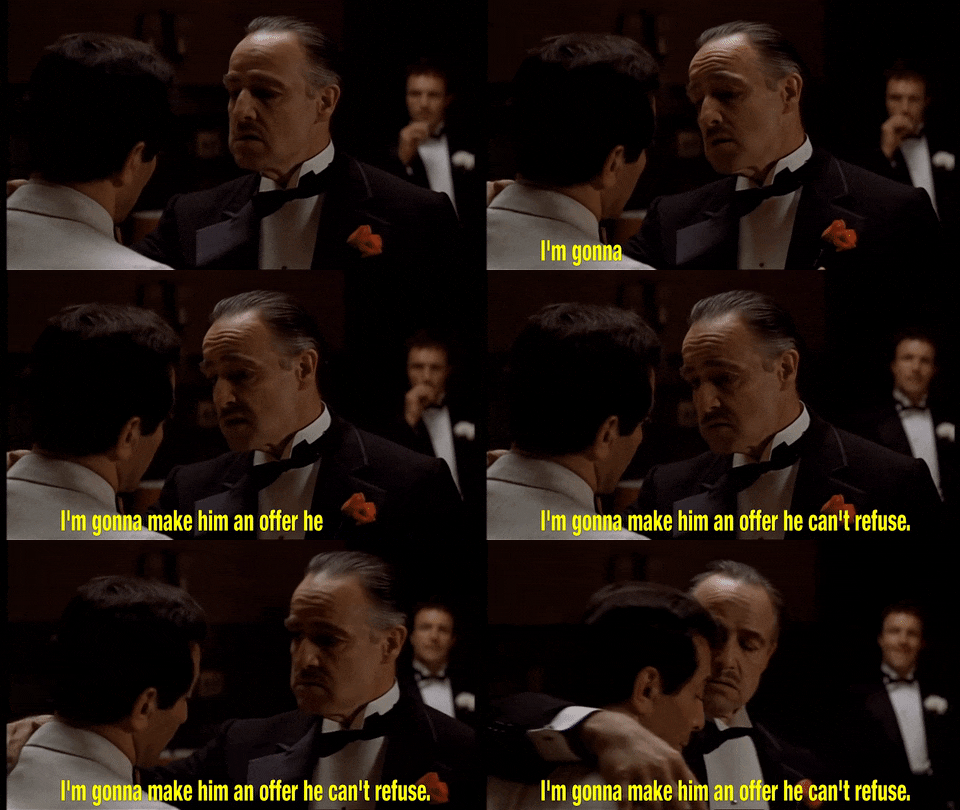
Yes, we know what you’re thinking, and you’re right: This is a real-life, crazy, big-tech-mafia-trying-to-pay-off-the-government plot!
|
|
|
Other Notable Headlines (That You Should Know About Too)
Walmart Gains Market Share, U.S. Ad Sales Up 26% - Q1 revenue was up 6% to $161.5M, beating estimates. Walmart's global ad business was up 24% including a 26% increase for Walmart Connect in the US.
Google Marketing Live 2024: Everything you need to know - Among the highlights are a new feature to allow marketers to use AI to quickly create high-quality creative assets for Performance Max campaigns and new AI-driven Shopping ads.
DCN Spins Off TrustX, Backs Startup Offering Information Symmetry - Digital Content Next is spinning off supply platform TrustX into a newly formed company called Symitri, which also just raised $5M in new capital.
Disney, Fox and WBD Unveil Name of Sports-Streaming Venture: Venu Sports - The bundle is set to go live in the fall, but pricing hasn't been revealed. Other hurdles include regulatory approval and a lawsuit filed by Fubo seeking to block the bundle.
Comcast Reveals Pricing for Netflix, Peacock, Apple TV+ Bundle - The product, called StreamSaver, will cost $15 per month and be made available to Comcast TV and broadband customers. Comcast will also add Netflix and Apple TV+ to its $30-per-month Now TV service, which also offers Peacock plus 40 free streaming services.
OpenAI Inks Data, Advertising Deal With Reddit - Reddit data will train OpenAI's generative AI models, and OpenAI will become a Reddit advertising partner. OpenAI CEO Sam Altman is one of Reddit's largest shareholders.
Amperity Redefines Composability with the World’s First Lakehouse CDP - The product lets companies more easily share live data sets between a CDP and a lakehouse without copying data.
Tealium unveils CDP integration with Snowflake’s Snowpipe Streaming API - The integration promises faster and more efficient data capture, processing, and activation.
Walled Garden Platforms Are Drowning Marketers In Self-Attributed Sales - It's a problem when walled gardens grade their own homework: They often take credit for conversions tied to campaigns that ran on their platforms, but many times that data doesn't reflect the advertiser's actual business performance.
The Billionaire Frank McCourt Mounts a Bid to Buy TikTok - The former owner of the LA Dodgers is talking about creating an "alternative to the current internet" that would give users greater control of their identity and data.
Scarlett Johansson says OpenAI copied ‘Her’ voice after she said no - She's threatening legal action.

|
|
|
That's it for this week's newsletter. Drop us a line with any questions / feedback.
The U of Digital Weekly Newsletter is intended for subscribers, but occasional forwarding is okay!
To subscribe visit Uof.Digital/Newsletters or contact us directly for group subscriptions.
And remember, U of Digital helps teams drive better outcomes through structured education on critical topics like programmatic, privacy / identity, CTV, commerce media, AI, and more. Interested in learning more about how we can supercharge your team? Let's talk.
Thanks for reading!
|
|
|
|